Graves
The following information mainly concerns the burials of forced laborers in the western part of the city of Wittenberg. Due to the local armaments industry, this area was the main center of the local Nazi camp system.

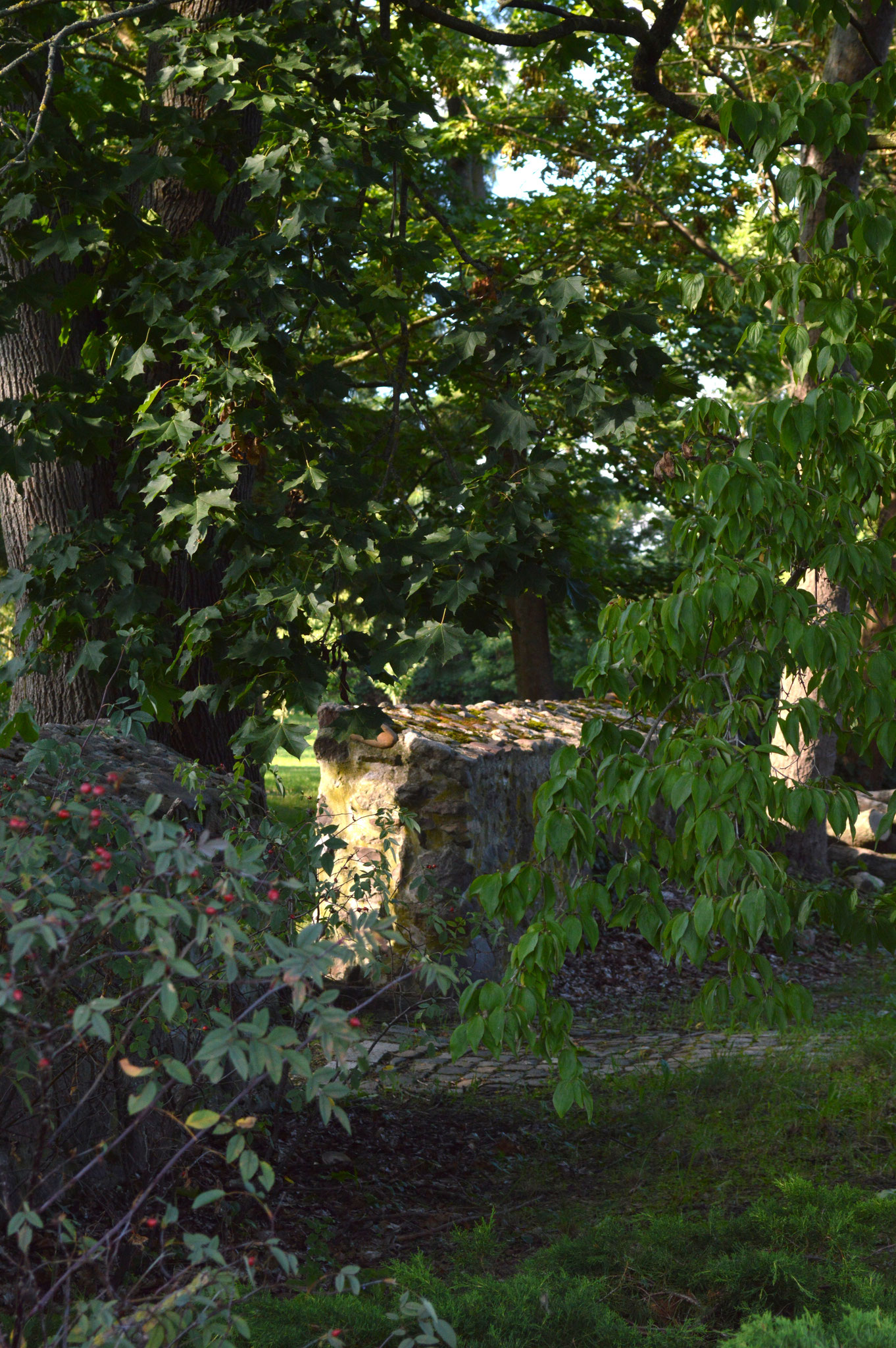


Shortly after the establishment of the forced labor camps in 1939, the first deaths occurred. The deceased were initially buried in municipal cemeteries, for example, in the old cemetery near the village church of Apollensdorf.
One village resident recalls seeing four female prisoners one morning (probably from the women’s section of the penal camp “Elberegulierung” Griebo) at the cemetery. Accompanied by female guards, they pulled a cart carrying a roughly assembled wooden coffin. At an open grave on the west side of the cemetery, they lowered the box. One of the women knelt down and began to pray, while the others quietly sang along. A guard interrupted them, ordered the woman to stand up and return to the cart. She had to remain there while the others shoveled in the grave. The burial site remained anonymous – without a cross, without a name.
Image Source: T. Keller
For the penal camp “Elberegulierung” Griebo, there are documented cases in which the families of deceased prisoners were given the opportunity to retrieve the bodies or, for a fee, to request urns. It is assumed that this practice was discontinued as the war progressed.
Shown here is the former mortuary of Apollensdorf. The scene was secretly photographed by a Czech father who, on that day in 1943, came to retrieve the body of his dead son.


Image Source 1: Městské muzeum a galerie Polička, Historická sbírka Hf 694, URL: https://cbmpolicka.cz/cz/sbirky/historicka-sbirka/6353-veznice-griebo
Image Source 2: T. Keller
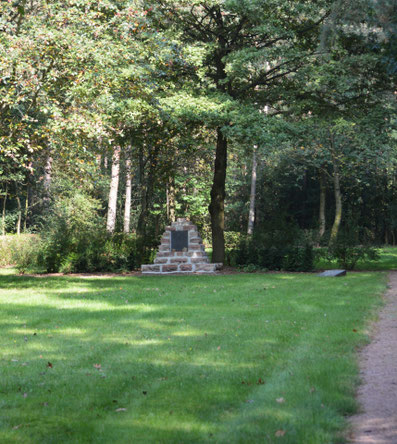
Image Source: A. Keller
As the Second World War went on, the number of forced laborers continuously increased. At the same time, living and working conditions in the camps deteriorated. By 1943, the number of deaths in the region had reached such proportions that the capacities of the municipal cemeteries were no longer sufficient. Consequently, an additional cemetery was planned in the western part of Wittenberg. This cemetery was specifically for deceased forced laborers established in Apollensdorf-Nord, in open fields outside the village. Locally it was referred to as the “foreigners’ cemetery” (“Ausländerfriedhof”) – a name reflecting the racist segregation between the so-called “national community” (“Volksgemeinschaft”) and the forced laborers discriminated against as “alien.”
The surviving prisoner Jaroslav Fryčka later recalled the burial of fellow inmates:
“In the prison infirmary, the dying prisoners presented a terrible sight. Although I was sick myself, one day I had to transport four dead men on a cart. We also had to undress them and put them into a box. Then we had to drive them to a cemetery and throw them into a mass grave. We had to bring the boxes and the clothes back.”
Between April 1943 and April 1945, a total of 488 deceased persons were buried in numbered individual graves at the Apollensdorf-Nord cemetery. They included men, women, and children from over 15 nations. While in the beginning mainly German prisoners were buried there, later Soviet forced laborers, the so-called “Ostarbeiter”, became the largest group among the deceased. The cemetery developed into a central burial site for numerous foreign victims of Nazi forced labor in the surrounding area.
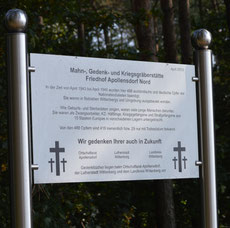
Today, the cemetery in Apollensdorf-Nord serves as a memorial and war grave site. In 2013, a historical documentation of the cemetery was undertaken by a group led by Dr. Peter Zollner. As part of this work, an information board was also installed. The burial ground is maintained by the municipality and visited during commemorative events.
Image Source: A. Keller
Some of the deceased were exhumed after the war and repatriated to their home countries. The Soviet dead were reinterred in a separate honorary cemetery in Wittenberg. How many graves remain at the Apollensdorf-Nord cemetery has not yet been determined.
There are no records of the exact number of Nazi forced laborers who died in the Wittenberg area. Not all of the deceased were buried in the so-called “foreigners’ cemetery.” In addition, some seriously ill and thus “unfit for camp” prisoners were transferred to other detention facilities, where many of them died. Forced laborers who were unable to work, particularly “Ostarbeiter”, were sometimes sent back to their home countries and left to their fate there.
Johanna Hohaus and Andreas Keller, 09.11.2025